Skip to content ↓

Post 16 Curriculum

Hill Campus  - Post 16 Cohort - 2025-26

Autistic Cohort 

Length of Lessons 

  • Average length of lesson in school for this cohort is 20 minutes per lesson although it can vary depending on the pathway of the learners.  
  • Learning should typically follow a cycle of regulation, work, break (including choice time).  
  • Scheduled break times should not extend beyond: 
  •  10 minutes choose - willow and oak pathway 
  •  15 minutes - juniper pathway  
  • Scheduled regulation should not extend beyond 15-20 minutes maximum across all pathways. There may be occasions that juniper requires longer but the plan should always be to return to the learning cycle once ready to engage. 

Number of Lessons to be covered 

  • Minimum of 3 lessons in the morning every day (unless including a specific extra curricular activity such as swimming, PFA, special event).  
  • Minimum of 3 lessons in the afternoon (this includes a 15 minute reflection lesson/ assembly) 
  • Cross curricular planning is actively encouraged in all lessons in this curriculum.  

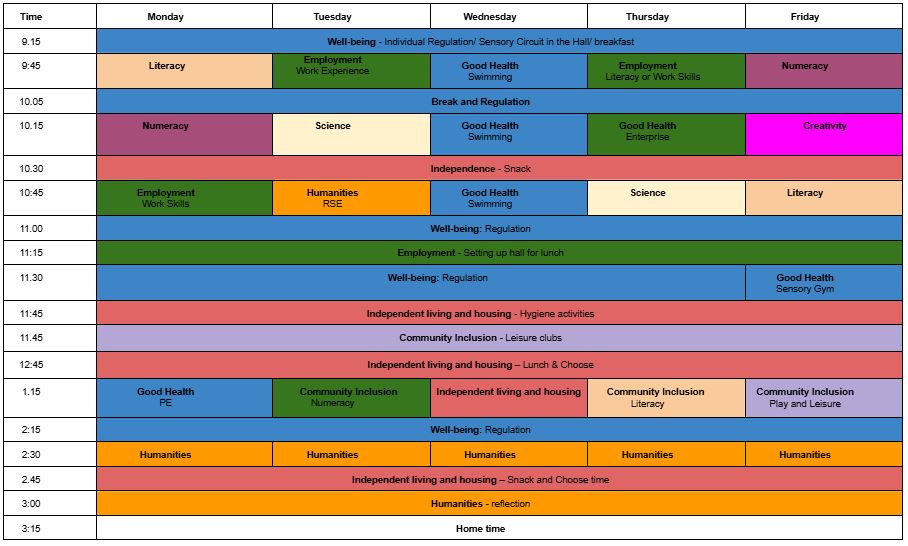
Sample Timetable

Core Subjects

Literacy

Numeracy

Science

Creativity

Humanities

  • Communication

  • Literacy - Personalised reading and writing including alternative pencil

  • To be embedded in every lesson:

  • Equals Five tier approach

  • Functional numeracy

  • ICT

  • Biology

  • Physics

  • Chemistry

  • Music 

  • Dance / performance

  • Art 

  • Drama

  • Photography

  • Reflection

  • Assembly

  • RSE

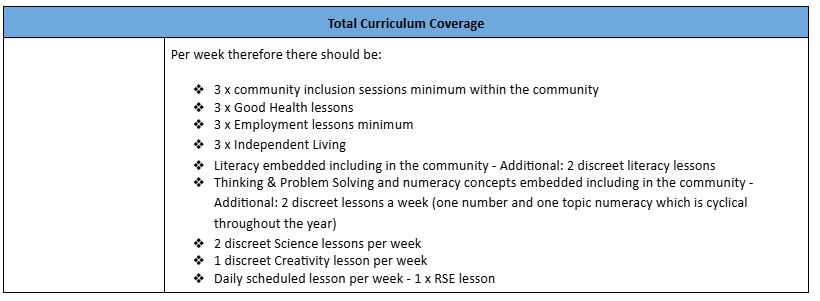
Expected Coverage

Literacy embedded including in the community 


Additional: 2 discreet literacy lessons 

Thinking & Problem Solving and numeracy concepts embedded including in the community


Additional: 2 discreet lessons a week (one number and one topic numeracy which is cyclical throughout the year)

2 discreet lessons per week


1 discreet lesson per week

Daily scheduled lesson per week 


1 x RSE lesson

Preparing for Adulthood

PFA - Community Inclusion

PFA - Good Health 

PFA - Employment

PFA - Independent

Living and housing

 
  • Community visits

    • Visiting parks, local shops, cafes, leisure centres etc

  • Community projects

  • Friends and Relationships

  • Leisure & Recreation in the community

  • Play & Leisure

       Type of play e.g. sensorimotor, cause/effect, functional, symbolic, socio- dramatic

  • Social Level of play e.g. solitary, parallel, shared, turn taking, cooperative

  • Healthy eating & lifestyle 

  • Mental Health & Well-being including SP regulation curriculum & Self-Reg

  • Sports, games & aquatics

  • Physical activities

    • PE - physical activity

    • Swimming

    • Rebound therapy 

    • Sensory circuits

  • Personal Hygiene

  • Accessing health services in the community

  • Embedded communication

  • Embedded thinking & problem solving skills

  • Work experience

  • Volunteering

  • Work skills

  • Making a positive contribution

  • Mini-enterprise

  • Embedded communication

  • Embedded thinking & problem solving skills

    • Functional numeracy

  • Dressing & undressing

  • Toileting

  • Transitions & travel training

  • Shopping

  • Cooking

  • Jobs in the home

  • Safety in the home

  • Technology

    • Environmental access

    • ICT

Expected Coverage

3 x community inclusion sessions minimum within the community


3 x Good Health lessons 


3 x Employment lessons minimum

3 x Independent Living


Curriculum Coverage