Early Years Foundation Stage (EYFS)
CURRICULUM OFFER
Intent
We acknowledge that our learners have a range of barriers to developing their skills from birth therefore we recognise the importance of highly specialist early years education in providing rich learning experiences as a springboard for their journey to adulthood. We identify the child’s existing strengths and skills and then build on these through playful interactions with people and the environment. Each child is unique and all staff have high aspirations for each child’s development. As a school we use the Birth to Five Matters (non statutory) guidance to support the implementation of the Statutory Framework for the EYFS set by the Department of Education.
The full Birth to 5 document can be found at the bottom of this page for reference.
We offer a curriculum that is ambitious, within an environment that ensures inclusion and adaptation to best support learning. We apply the EYFS framework and the four themes of the EYFS inform our practice. These are: A Unique Child, Positive Relationships, Enabling Environments and Learning and Development.
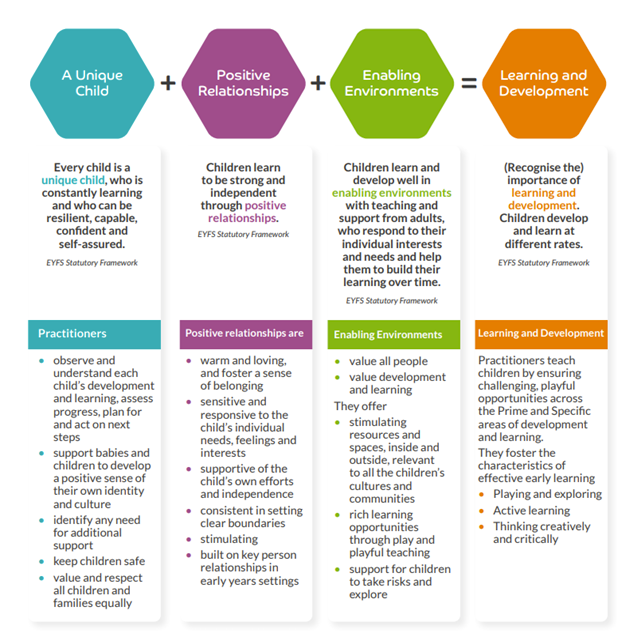
Our learners follow the EYFS curriculum throughout the Early Years (Nursery and Reception), some continue to access the EYFS curriculum into Year 1 to support their transition into one of our pathways for learning which outline the way the curriculum is delivered to that cohort. The EYFS curriculum is a developmental curriculum which plays a diagnostic role in establishing which pathway the learner will follow.
Implementation
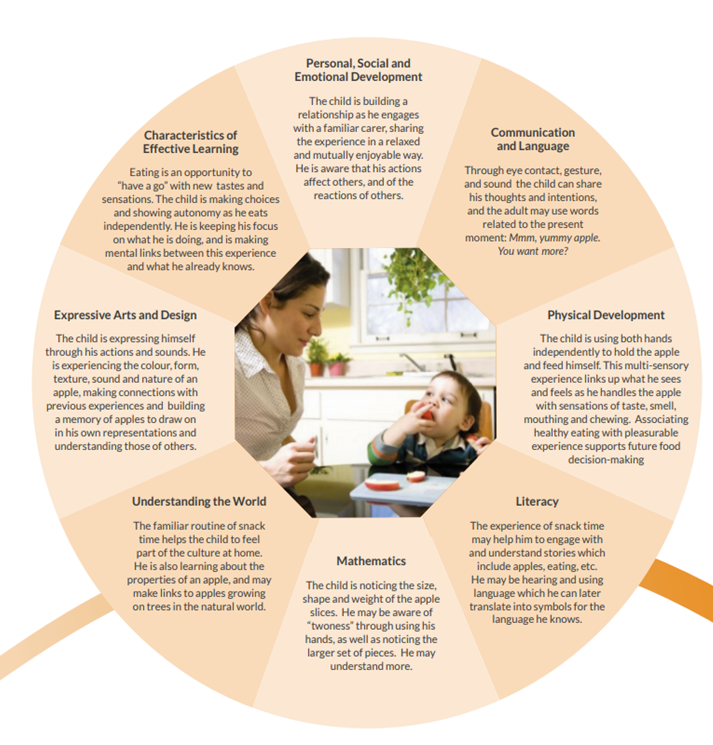
We pride ourselves on our individualised, trans-disciplinary approach to learning; with the child and their family at the heart of our practice. We have a strong focus on learning and developing through play and playfulness. We provide opportunities for learners to take part in activities that build on and extend their interests and develop their abilities in the areas of social, emotional and communication skills. We provide opportunities for learning in different environments (indoors, outdoors and in the community) using a wide range of specialist resources and equipment to support each child’s individual differences/preferences and complex needs. We aim to create a learning environment that facilitates the active engagement and participation of our learners, using motivating and meaningful activities. The subject areas are:
Impact
Children in Early Years frequently achieve well at our school. The culture and ethos of our school results in the expectations of what our learners can achieve being high and realised. The highly specialised, transdisciplinary approaches have enabled our children to progress from their individual starting points and prepared them for the next stage in their education, this includes beginning to understand communication systems, early regulation skills and promoting physical autonomy and independence.
Assessment
Impact is measured in a variety of different ways including the national EYFS baseline assessment (where appropriate), against the national EYFS statutory assessment framework (including feedback on readiness for effective learning), internal holistic progress tracker and PLPs. We ensure that all our assessment methods are purposeful and directly impact the pupils. Whilst many of our learners will not meet the expected levels of EYFS statutory assessment framework we ensure families receive a report which celebrates their small step progress throughout the year.
Educational, Health and Care Plan (EHCP)
Children in the Early Years will have recently been issued with their first EHCP. In line with statutory guidance, reviews for learners under the age of 5 take place every six months in order to capture initial progress and to ensure the EHCP remains accurate and relevant.
Evidence for Learning
Evidence for Learning is a secure online portfolio that allows teachers to document and reflect on pupils’ engagement and progress within school. Each student has their own individual framework, derived from their Educational, Health and Care Plan, where pictures, videos and messages can be shared between school and home. This also allows practitioners to reflect on learning and plan accordingly. Development in the areas of the EYFS curriculum are incorporated into our assessment.
Personalised Learning Plans/Next Steps
Each pupil has a personalised learning plan (PLPs). These plans are linked to achievement of the long term outcomes within the Education Health Care Plan (EHCP) alongside strategies and programmes being utilised to support the achievement of these. The transdisciplinary team around the child reviews and reports on progress. Parents' views are taken into consideration when setting and reviewing targets. These targets are embedded in a cross-curricular way throughout the school day. Progress and documentation are regularly shared with parents.
Curriculum Assessment
All learners have a curriculum assessment book that baselines and tracks their progress in each subject area of the curriculum for the duration of their learning journey with us. Progress is reviewed annually as part of each learner’s annual review cycle.
Holistic Assessment
All learners have holistic risks, provision and progress tracked by the TDT team on a termly basis using our holistic LEARN tracker. The team around the child baseline and track holistic progress across key areas, identifying risks and the impact of changes in provision in order to ensure that each learner’s aspirational outcomes are realised. This information is summarised and reported annually as part of the annual review process.
The Engagement Model
“Effective use of the engagement model is based on regular observational assessment and reflective pedagogy. Observational assessment is central to understanding what the pupil knows and what they can do. It is the most reliable way of building up an accurate picture of pupil’s progress” (The Engagement Model, 2020) Practitioners are continually encouraged to reflect on observations using the 5 areas of engagement which are- exploration, realisation, anticipation, persistence and initiation. We use our reflective feedback to inform and personalise planning and to make sure our core curriculum offer is engaging for all.
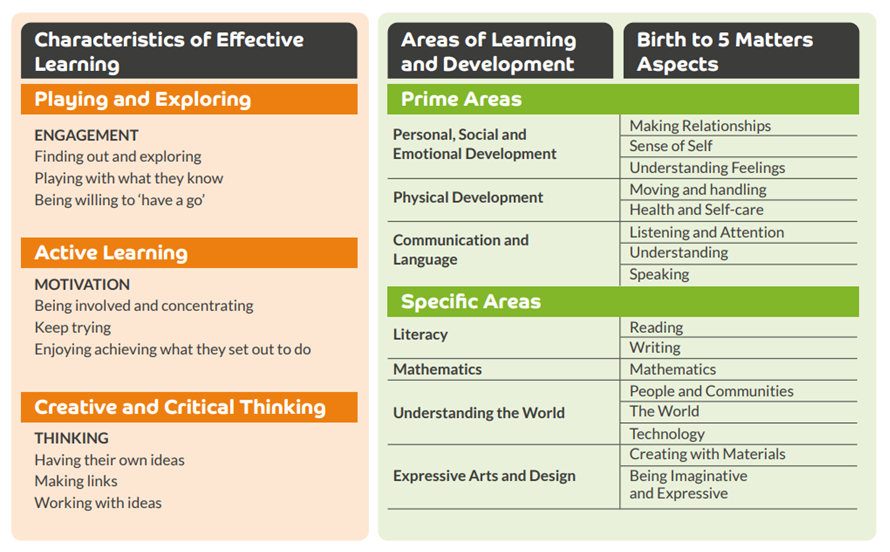
Characteristics of Effective Learning
We measure the impact of our curriculum by ensuring that characteristics of effective learning are being observed. We adapt planning accordingly to ensure we are enhancing learning opportunities.
We implement the statutory requirements of the EYFS with the support of the Birth to Five Matters guidance.
Outcomes for learners
The evidence based Early Years Foundation Stage curriculum provides a framework for learning to build foundation skills in the above seven areas of learning and development. Its diagnostic role allows learners to be appropriately placed into the correct curriculum pathway for their transition into Key Stage one.