Key Stage 1 - 4
CURRICULUM OFFER
Intent
Our Sherwood Foundation School curriculum delivers a broad and bold curriculum which meets the diverse needs of pupils. The curriculum utilises elements from a range of sources to create a continuum of learning which equips our learners with a breadth of knowledge and skills in all areas of learning. Our curriculum uses sources including the National Curriculum, the Equals Curriculum, Shanker’s Self Reg, Greenspan’s DIR Floortime, Making Words and Kelly Mahler’s Interoception Curriculum. As a school we are committed to evidence-based practice and quality first teaching. With the right environment and support, we strive for our learners to become better regulated young adults who are able to communicate conventionally to convey their aspirations for adulthood.
Implementation
Sherwood Foundation School prides itself on our individualised, trans-disciplinary approach to learning; with the child and their family at the heart of the curriculum. The curriculum has six core subjects; communication, literacy, numeracy, health and wellbeing, play and leisure and sensory and physical development. As pupils move through the key stages they continue to develop their skills in the core subject areas which support their learning across the breadth of the curriculum. There are also six foundation subjects; humanities (covering history, geography and RE), science and technology (covering science, ICT and design technology), and creativity (covering art, music, drama and dance). These provide the broad and bold curriculum which offers our pupils the same breadth as their mainstream peers.
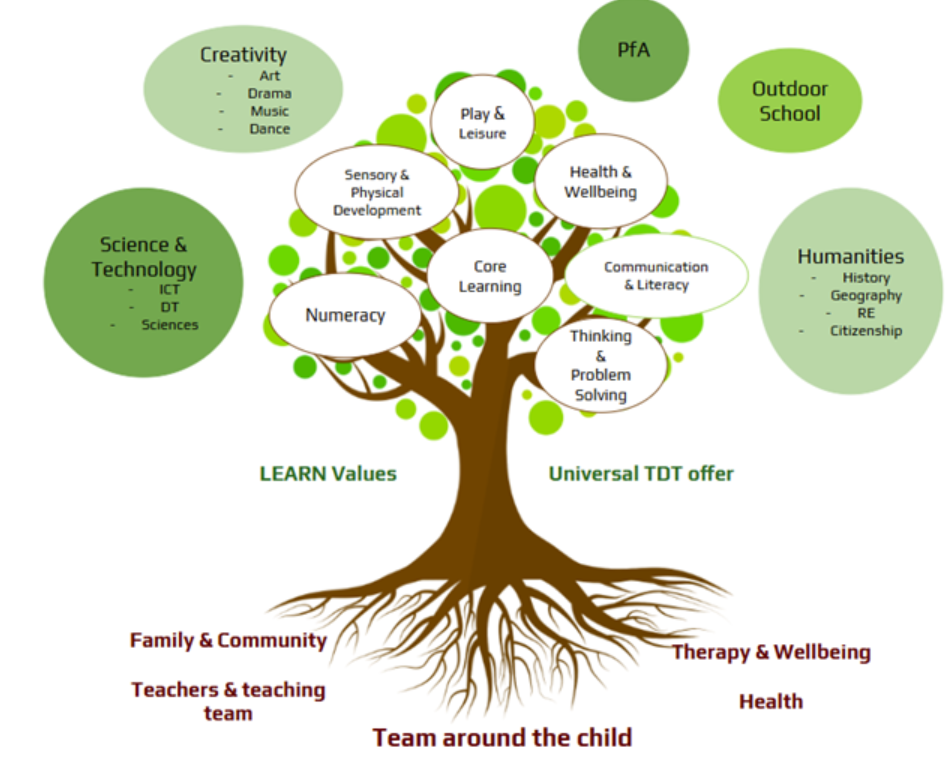
Curriculum coverage
The implementation of the curriculum differs according to the pathway the learner is following and is closely linked to their learning style. Some of our learners will benefit from all subjects being taught in discreet lessons, ensuring that communication, thinking and problem solving, wellbeing and independence are embedded within all lessons. Other pupils will benefit from a cross curricular approach whereby foundational skills are taught across all curriculum areas but with subject specific activities to cover the breadth and depth of the curriculum.
Impact
EHCP - Assessment and Outcomes
When our learners start with us at Sherwood Foundation School we complete a trans-disciplinary baseline assessment within the first term. This involves collaborative working between teachers, parents, carers, speech and language therapists, occupational therapists and external agencies in order to provide a comprehensive picture of the learner’s strengths, individual differences and barriers to learning. From this baseline, the trans-disciplinary team works with the learner and their family to ensure that personalised, aspirational outcomes are set in the areas of cognition & learning; communication & interaction; social, emotional & mental health; and sensory & physical. These are formally reviewed at the end of each key stage and at the child’s annual review of their EHCP. This is supported by qualitative assessment and observations by the teaching and therapy staff, supplemented by quantitative data from trans-disciplinary and discipline specific standardised assessments including the Vineland assessment, the Functional Emotional Developmental Capacities (FEDC) checklist, the Augmentative and Alternative Communication (AAC) profile, the Communication matrix, the Assessment of Learning Process for Augmentative Communication, the Stepping Stones to Switch Access and Therapy Outcome Measures (TOMs).
Personalised Learning Plans (PLPs)
Depending on the pathway that a child is on, their EHCP outcomes will either be broken down into termly targeted personal learning programmes (PLPs) or into a multitude of component parts that are worked on simultaneously to achieve the end of key stage outcome. This is dependent on the pupils rate of progress. Both targets and components are reviewed and updated as part of our transdisciplinary assessment process in collaboration with parents. This is supported by qualitative assessment and observations by the teaching and therapy staff documented through progress summaries and Evidence for Learning (EfL), supplemented by quantitative data from PLP reviews. These PLPs are then embedded into the curriculum.
Evidence for Learning (EfL)
Evidence for Learning (EfL) is a secure online portfolio that allows teachers to document and reflect on pupils’ engagement and progress within school. Each student has their own individual framework, derived from their Educational, Health and Care Plan, where pictures, videos and messages can be shared between school and home. This also allows practitioners to reflect on learning and plan accordingly. Statutory frameworks such as the Pre-Keystage Standards and Engagement Model are also assessed via EfL.
Curriculum Assessment
All learners have a curriculum assessment book that baselines and tracks their academic progress in each subject area of the curriculum for the duration of their learning journey with us. Progress is reviewed annually as part of each learner’s annual review cycle.
Holistic Assessment
All learners have holistic risks, provision and progress tracked by the TDT team on a termly basis using our holistic LEARN tracker. The team around the child baseline and track holistic progress across key areas, identifying risks and the impact of changes in provision in order to ensure that each learner’s aspirational outcomes are realised. This information is summarised and reported annually as part of the annual review process.
Outcomes for Learners
Learners develop both academically, within their subject knowledge and skills, but also personally in their communication, health and wellbeing and sense of self, preparing them for a smooth transition to the next stage in their education. With key aspects of the curriculum mirroring natural milestones for pupils in their lives, such as toilet training and puberty, pupils gain an understanding of their own bodies and the daily living skills required to lead fulfilled lives with as much autonomy and independence as possible.